

Personal Growth

Write the Vision

A Word For The Purposeful: Write the Vision, Make it Plain

A Word For the Purposeful: Write the Vision, Make It Plain “Write the vision, and make it plain upon tables, that he may run that readeth it.” HABAKKUK 2:2–3 · KJV  There is something sacred about a vision written down. Not merely dreamed, not only spoken into the air — but inscribed, set before you, made plain. God gave the prophet Habakkuk more than a word; He gave him an instruction about how to steward that word. And that instruction is just as alive for us today. “And the LORD answered me, and said, Write the vision, and make it plain upon tables, that he may run that readeth it. For the vision is yet for an appointed time, but at the end it shall speak, and not lie: though it tarry, wait for it; because it will surely come, it will not tarry.” Habakkuk 2:2–3, KJV God Has Already Spoken Over Your Life Habakkuk was in a season of waiting — frustrated, questioning, watching the world around him unravel. And yet, in the midst of that tension, God did not silence him. He answered him. He gave him a vision. And then He told him: write it down. This is the first thing we must understand: God’s will for your life is not hidden in confusion. God speaks. He reveals. He points. Often what we call “searching for God’s will” is really a call to be still enough — attentive enough — to hear what He has already been saying. The vision God places in your heart is not an accident. It is appointment. Why God Says Write It Down The Lord didn’t just say “remember the vision.” He said write it, and make it plain. There is divine wisdom in this instruction. A vision kept only in your mind is vulnerable — to doubt, to distraction, to the fatigue of difficult seasons. But a vision written down becomes an anchor. When you write the vision, you do several powerful things at once: you declare it as real, you create accountability to it, and you give others the ability to run with it alongside you. “That he may run that readeth it” — a written vision can be shared, can inspire, can multiply beyond what any single person could carry alone. The Four Pillars of a God-Given Vision PILLAR ONE Clarity: Make It Plain A vague vision produces vague action. God’s instruction is not merely to write, but to write plainly — so clearly that someone reading it could move with purpose. Ask yourself: if someone else read your vision, would they know what it looks like when it comes to pass? Clarity is an act of faith. It says, “I believe this well enough to describe it.” PILLAR TWO Alignment: Submit It to God Planning without prayer is presumption. Before you map out the steps, take the vision back to the One who gave it. Ask: Is this truly from You? Does this honor You? Is this about Your kingdom or mine? A vision aligned with God’s will carries His authority — and His authority is what makes the impossible possible. PILLAR THREE Action: Plan the Steps Proverbs 21:5 tells us that “the plans of the diligent lead surely to abundance.” Faith without works is dead — and a vision without a plan is just a wish. Once you have written the vision plainly and submitted it to God, it is time to steward it with diligence: break it into seasons, milestones, and concrete daily actions. PILLAR FOUR Patience: Wait for the Appointed Time “The vision is yet for an appointed time.” This is not a dismissal — it is a promise. God is telling Habakkuk, and us, that the vision has a due date already set in heaven. Our part is not to force the fruit before the season, but to remain faithful in the waiting, trusting that what God has spoken will not lie. Planning Is Not a Lack of Faith Some well-meaning believers hesitate to plan, fearing it implies they don’t trust God. But look at Scripture again — God Himself is the ultimate planner. God ordained the days of the earth before creation. He appointed times and seasons. He told Noah exactly how to build the ark, Moses exactly how to build the tabernacle. Planning, done prayerfully and submitted to God’s will, is an expression of stewardship — and stewardship honors God. The goal is not a rigid plan that leaves no room for the Holy Spirit to redirect you. The goal is a living document — a written vision held loosely enough for God to refine, but firmly enough to give you direction when life gets loud and the enemy whispers doubt. “Commit your works to the LORD, and your thoughts will be established.” PROVERBS 16:3 · NKJV How to Write Your Vision Here is a simple, practical framework — grounded in the pattern God gave Habakkuk — to help you write your vision and make it plain: Pray first. Before pen meets paper, enter into prayer and silence. Ask God to speak, and listen. Journal what you sense Him saying — about your purpose, your season, your calling. This is the raw material of your vision. Write the vision statement. In one to three sentences, articulate what you believe God has called you to. Make it specific, present-tense, and faith-filled. Not “I hope to one day…” but “God has called me to…” Describe what it looks like in full bloom. Write a vivid description of what it looks like when the vision has fully come to pass. Who is impacted? What has changed? What does your daily life look like? Let the Spirit paint the picture. Break it into seasons and steps. What does this year look like? This month? This week? Identify the next faithful step — not the whole staircase, just the next step. And take it. Put it where you can see it. “Upon tables” — in plain sight.

A Word For The Purposeful: Write the Vision, Make it Plain Read More »
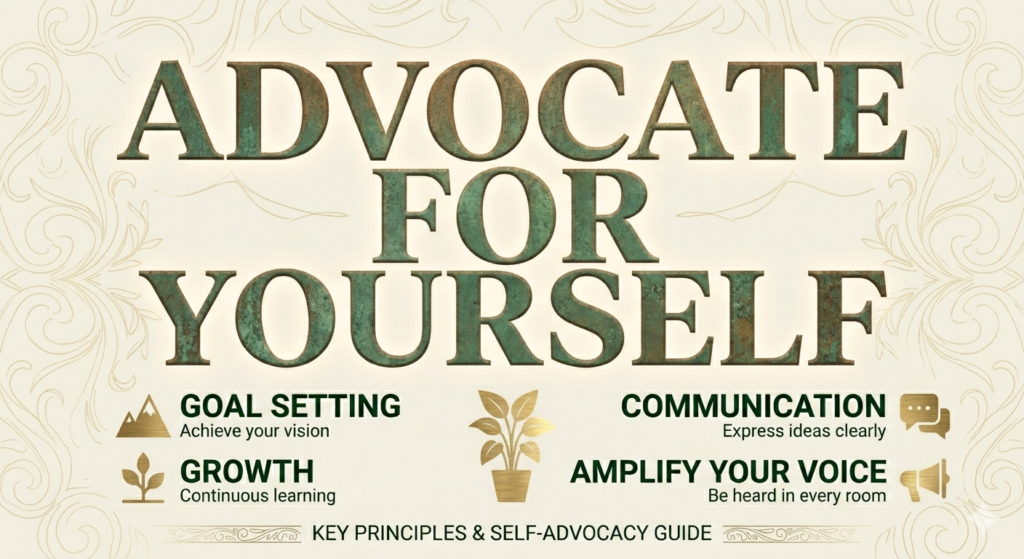
Advocate for Yourself

How to Advocate for Yourself Without Being Labeled “Difficult”

How to Advocate for Yourself Without Being Labeled “Difficult” Standing your ground doesn’t mean starting a fight. It means knowing your worth — and finally being done with shrinking to make other people comfortable. Let me guess. You’ve been in a situation where something wasn’t right — a decision made without you, a boundary crossed, an opportunity that should have been yours — and instead of saying something, you talked yourself out of it. You told yourself it wasn’t worth the drama. That you’d be seen as “too much.” That it was better to just let it go. I’ve been there. Most of us have. And that pattern — swallowing things to keep the peace — doesn’t feel like strength. It feels like survival. But over time, it costs you. Your confidence. Your opportunities. Your sense of self at work. Here’s what I want you to know: you don’t have to choose between speaking up and being respected. You can do both. The difference usually isn’t what you say — it’s how, when, and why you say it. Stop reacting. Start responding. Most self-advocacy that backfires happens in the heat of the moment. Someone dismisses your idea in a meeting, and something rises in your chest — frustration, embarrassment, maybe a flash of anger. You respond immediately. Even if everything you say is right, the emotion becomes the story. Intentional advocates pause. Not to suppress what they’re feeling, but to ask themselves: What outcome do I actually want here? What’s the most effective way to get it? Feelings are informational. They just shouldn’t be the first thing out of your mouth if you want to be taken seriously. Give yourself a beat. You don’t have to have the conversation in that room, in that moment. A well-timed follow-up is almost always more powerful than a reactive one. Speak in outcomes, not complaints. This one changed everything for me, and it’s so simple it almost feels like a trick. Framing matters more than most people realize. “I’m constantly being talked over in meetings” lands as a complaint. “I want to make sure the team is getting the benefit of everyone’s thinking — can we try a round-robin format?” lands as leadership. Both describe the exact same problem. But one makes people defensive, and the other makes them curious. When you anchor your ask to a shared goal — team performance, project success, a better outcome for everyone — you make it much harder to dismiss. You’ve made it about something bigger than you. That’s not manipulation. That’s strategy. Get specific before you speak. Vague concerns are easy to wave away. Concrete patterns are not. Before raising something significant, spend a few days noting specifics — dates, examples, impact. Not to “build a case” in a hostile way, but so you walk in grounded instead of just frustrated. “This always happens” invites a debate about your memory. “I noticed this three times in the last two weeks, and here’s the impact” invites a solution. One feels like venting. The other feels like a professional conversation. Choose the right room. Advocating publicly, in front of an audience, raises the stakes for everyone — including you. The other person gets defensive. You get labeled. Nobody wins. Whenever you can, have these conversations privately first. A one-on-one with your manager. Direct messages asking to connect. A follow-up email after a meeting. These lower the temperature and open the door to an actual dialogue. Public escalation is sometimes necessary — but let it be a last step, not a first impulse. Show up this way consistently. Here’s something nobody tells you: people who only speak up when they’re upset get labeled reactive. People who speak up regularly — in small ways, across good moments and hard ones — get labeled confident. Build the habit of naming your contributions, asking clarifying questions, and stating your preferences before situations become problems. When self-advocacy is just part of how you operate — not a special event, not a crisis response — it stops reading as a challenge and starts reading as character. You are not “difficult” for having needs, opinions, and standards. You’re a professional with something to contribute. The goal isn’t to make yourself smaller so other people feel comfortable. It’s to make your value legible — to the people who shape your opportunities, and to yourself. Do it with clarity, with calm, and with consistency. That’s not being difficult. That’s being someone people learn to take seriously. P.S. This is something I am working on. Something I still struggle with.

How to Advocate for Yourself Without Being Labeled “Difficult” Read More »

Order My Steps

Order My Steps – Learning to trust the path God has already planned

Order My Steps – Learning to trust the path God has already planned I have goals. Big ones. A list that never seems to get shorter, dreams that wake me up before my alarm goes off, and a vision for my life that feels enormous some days — and impossibly far away on others. I know what I want. I know where I want to go. And yet, I’m learning something quietly radical: the path there isn’t entirely mine to plan. “The steps of a good man are ordered by the Lord, and He delights in his way.” — Psalm 37:23 (NKJV) That verse doesn’t say the destination is taken from you. It doesn’t say your desires don’t matter. What it says is that the steps — those specific, daily, sometimes-confusing moves from one season to the next — are ordered by the Lord. He’s not just watching; He’s directing. And there’s a profound peace in that, if we let it settle. More Than a Song If you’ve ever heard the song “Order My Steps” by GMWA Women of Worship, you know there’s something in that melody that reaches past music and lands somewhere in the chest. The lyrics are a prayer as much as a song — a surrender, an invitation. Order my steps in Your Word, dear Lord. Lead me, guide me every day. That song resonates because most of us have felt it: the tension between our plans and God’s plan. We make our lists, we set our timelines, and then life unfolds differently — sometimes better than we imagined, sometimes harder, almost always more layered. The song is a reminder that we don’t have to navigate that tension alone. We can invite God into the middle of it. Holding Goals Loosely Here’s what I’ve had to wrestle with: having big goals and surrendering to God’s will are not opposites. They were never supposed to be. The faith-based principle of God ordering your steps doesn’t call you to passivity. It calls you to partnership.”You can hold your dreams tightly and still hold them with an open hand.” Proverbs 16:9 says it plainly: “A man’s heart plans his way, but the Lord directs his steps.” You still plan. You still dream. You still show up and do the work. But you remain open — genuinely open — to the possibility that God may redirect you, reroute you, or reveal something better along the way than what you originally wrote down. What “Ordered Steps” Look Like in Practice Trusting God to order your steps isn’t a vague, passive hope. It’s an active posture. Here are a few ways I’m practicing it: Pray over your plans, not just your problems. Don’t only bring God your crises. Bring Him your goals, your ambitions, your five-year plan. Lay them before Him and genuinely ask Him to affirm, redirect, or reshape them. Pay attention to open doors — and closed ones. Sometimes a “no” is protection. Sometimes a delay is preparation. The doors God opens and closes are part of how He orders your path, even when the closed ones sting. Move when you sense the nudge. Ordered steps still require your feet to move. Faith without works is still dead. God will direct you — but often, He directs you while you’re already in motion. Release the timeline. This one is the hardest. Our timelines are rarely God’s timelines. What looks like delay from our perspective may be divine preparation from His. Trust the timing as much as the direction. Stay anchored in His Word. “Order my steps in Your Word” — not just in feelings, circumstances, or what makes sense to us. Scripture is the compass that keeps everything else calibrated. The Permission to Want One thing I never want to lose in this journey of surrender is the understanding that God gave me these desires for a reason. Psalm 37:4 says He gives us the desires of our hearts — but only after we delight ourselves in Him. The desires themselves aren’t ungodly. The order of things matters. When He’s first, the wants and the will start to align in ways that feel less like striving and more like flowing. The goals don’t disappear — they get sanctified. They get purpose behind them that outlasts the achievement itself. So yes, I have a lot I want out of this life. Yes, I have goals that light me up when I think about them. And yes — I’m learning to hold every single one of them with a hand that stays open, because I’m trusting the God who already knows every step I’m going to take before I take it. “He doesn’t just know where you’re going. He’s already been there, clearing the way.” Let Him order your steps. Not because your plans don’t matter, but because His plan is bigger than anything you could write down. The best things in your story may not even be on your list yet.https://www.youtube.com/watch?v=IMfo1G9ouGU&list=RDIMfo1G9ouGU&start_radio=1

Order My Steps – Learning to trust the path God has already planned Read More »